


Why Schools Are Surprisingly Hard on Windows
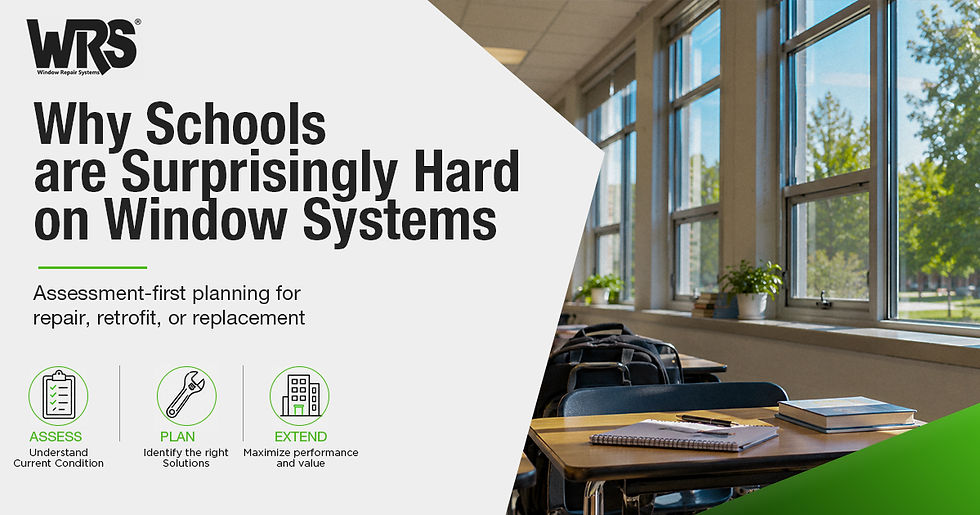
School windows may seem like passive building components, but they often operate in one of the more demanding environments a commercial window system can face.
Classrooms, hallways, gyms, cafeterias, offices, and other occupied spaces can put window hardware through years of repeated use. Add in large sash sizes, changing ventilation needs, constant occupancy, and the realities of everyday school activity, and small window problems can add up quickly.
More Daily Use Than It Seems
An operable school window may be opened, closed, locked, unlocked, and adjusted many times throughout the school year.
That repeated movement places ongoing demand on balances, locks, operators, latches, hinges, and other hardware. Even when each individual use seems minor, the accumulated cycles can contribute to wear over time.
Larger Windows Can Mean Greater Demands
Many institutional windows are larger or heavier than typical residential units.
That can place more responsibility on the hardware supporting and controlling the sash. Balances must properly counteract the sash weight, locks must maintain alignment, and operators or hinges may be responsible for moving larger assemblies.
When those components begin to wear or fall out of adjustment, the difference can become noticeable quickly.
Not Every User Treats a Window the Same Way
School windows are also operated by many different people.
One person may open a sash carefully while another pushes, pulls, or closes it with considerably more force. Students, staff, custodians, and maintenance teams may all interact with the same window differently.
Over time, inconsistent or forceful operation can contribute to loose hardware, damaged components, alignment problems, or accelerated wear.
Ventilation Can Increase Seasonal Use
Window usage may also change throughout the year.
During mild weather, classrooms and other spaces may rely more heavily on operable windows for additional airflow. That can mean periods of increased opening and closing compared with other times of the year.
Windows that are already difficult to operate may become especially noticeable when occupants begin using them more frequently.
Maintenance Has to Work Around the School
Repairing a commercial window in an occupied school is rarely just a matter of replacing a part.
Access may need to be coordinated around classrooms, students, staff, or school schedules. Elevated windows may require additional equipment. Larger projects may need to be phased around breaks, summer work, or other facility activities.
That means even relatively small hardware issues can become more complicated once scheduling and access are added to the repair.
Repeated Failures May Be Telling You Something
One failed balance or broken latch may simply be an isolated repair.
The same failure appearing repeatedly across similar windows is different.
If certain window types, hardware components, or areas of the building continue experiencing the same problems, it may be worth looking at the larger pattern rather than treating every repair as unrelated.
That can help facility teams better understand what is installed, which components are wearing most often, and where a more coordinated repair or retrofit approach may make sense.
School Windows Need a Practical Approach
School windows are expected to provide light, ventilation, security, and everyday functionality while operating in a demanding environment year after year.
That does not mean every aging or difficult window needs to be replaced. In many cases, repair, updated hardware, targeted retrofit work, or other improvements may help keep an existing system operating effectively.
At Window Repair Systems, we evaluate commercial and institutional window systems with the building, application, and long-term maintenance needs in mind.
Because in a school, the window is only one part of the challenge.


Comments